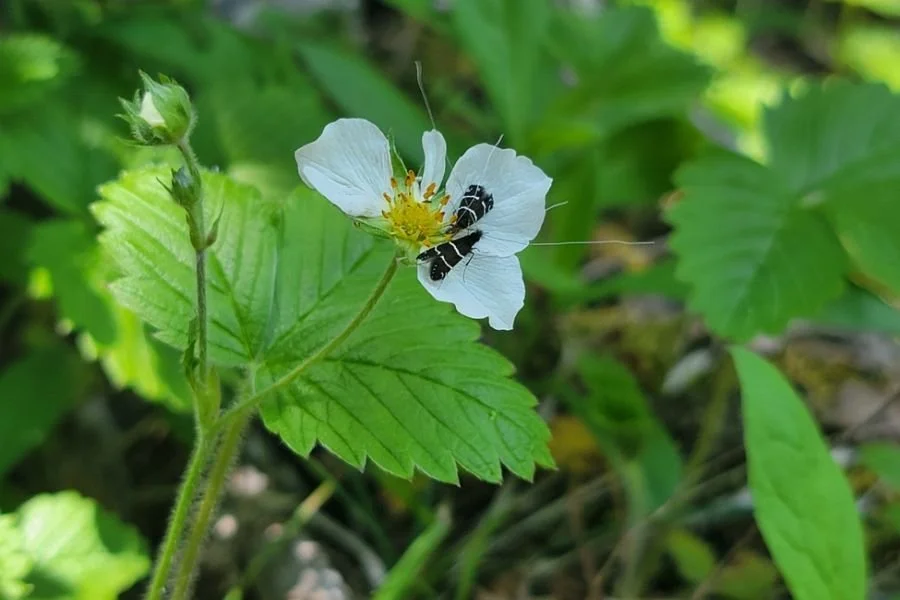
As it is in our nature to protect all fairies, it is no surprise to discover Fairy Longhorn Moths snuggling up on a mountain strawberry flower at Sharon Fen Preserve. Fairy Longhorn Moths are micromoths in the order Lepidoptera, family Adelidae, and known for their VERY long thread-like antennae, which shimmer brightly in the sun. These white antennae are 1-3 times as long as their total wing length (4-6mm), roughly the size of a pinto bean.
Adelidaes occur throughout North America, Africa, and Eurasia. Some species are sexually dimorphic where different sexes of the same species exhibit different physical characteristics beyond their reproductive parts. For instance, the female of the Ocean Spray Fairy Moth has an orange head while the male exhibits a black head. The common Fairy Longhorn Moths range from British Columbia to northern Mexico. They are often encountered on or near their host plants, which include Ocean spray, Owl’s clover, and Gilia.
Adults of the Adelidae family are diurnal (active during the day) as many other moth species are. Because these precious pollinators are flying about at the same time as butterflies they are often mistaken for a butterfly. A simple trick to identify a moth from a butterfly is looking at the wings while the insect is resting. If the wings are folded up it is generally a butterfly. If the wings lay flat you are usually observing a moth.
Moths are an important food source for songbirds, mammals, lizards and other insects. Caterpillars (larvae of moths) are loaded with protein, making them the number one resource for breeding bird success. Moths also play a key role in decomposition by consuming leaf matter, adding nutrients like nitrogen and phosphorus to the nutrient cycle. Those nutrients feed plants, which then mature into beautiful flowers for pollinators to conduct their magic. One study found nocturnal moths visit more plant species than day active bees showcasing their significant role as pollinators.
Leckie, Seabrooke “Moths of Western North America” Princeton Field Guides 2026.
Fox, Alex. “Moths Work the Pollination Night Shift, Visiting Some Flowers Bees Skip.” Smithsonian magazine, May, 2020 Read Full Article Here